
Windage Artist in Residence at UA Little Rock Application
Portfolio
Narong Tintamusik
Viewing Instructions:
Select images come in a set and have alternative or detail views. Click on the smaller images below the large main images for viewing.
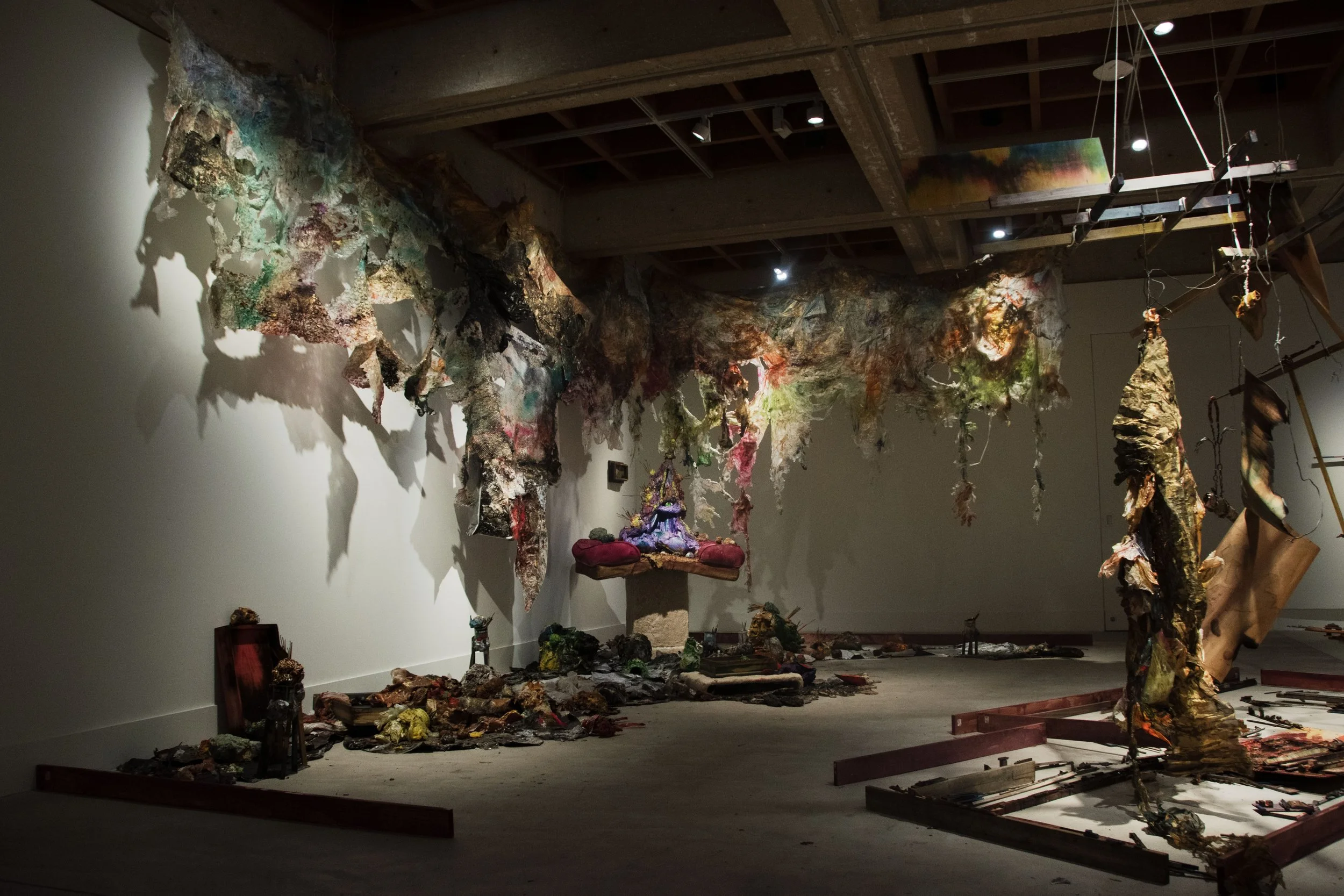
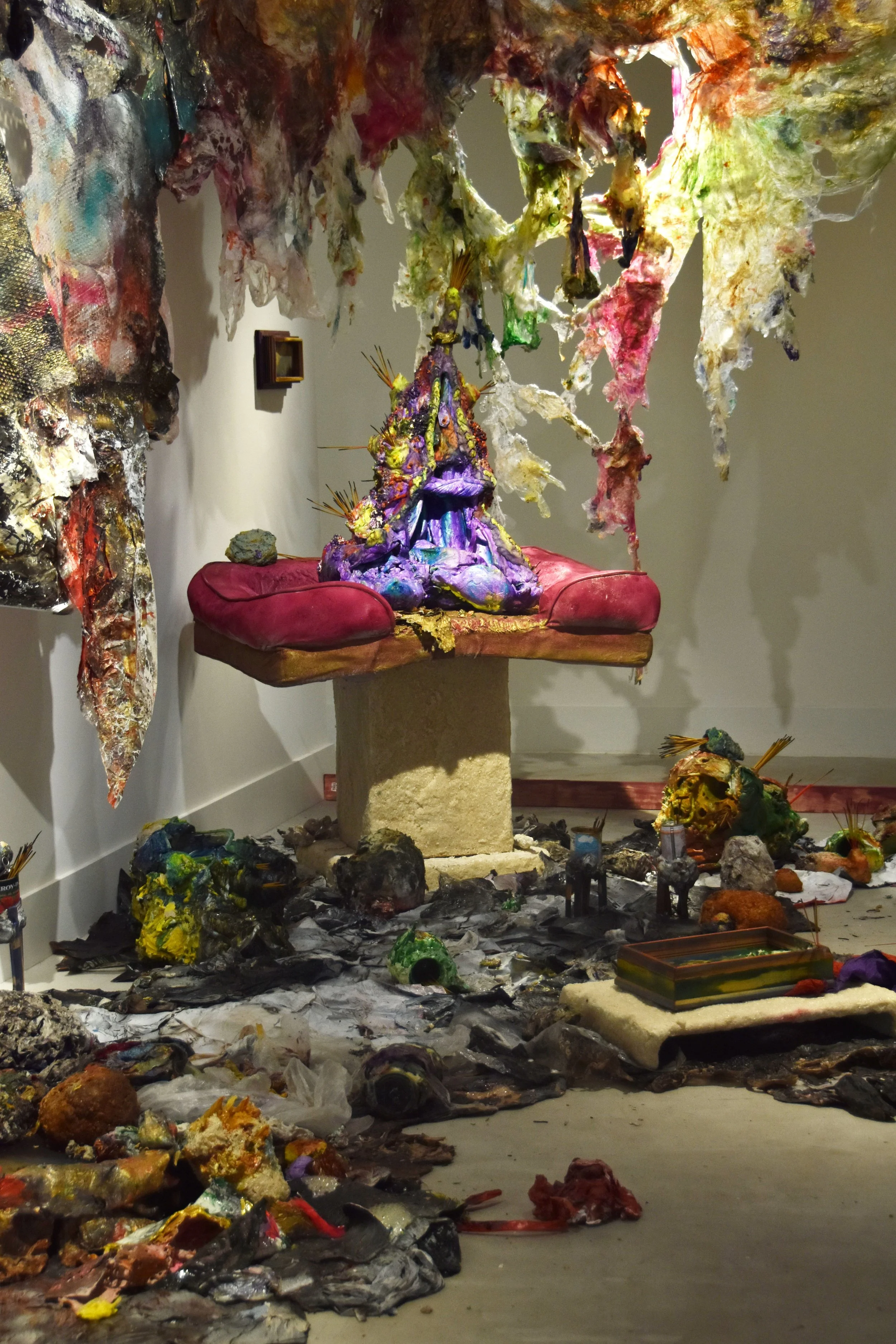
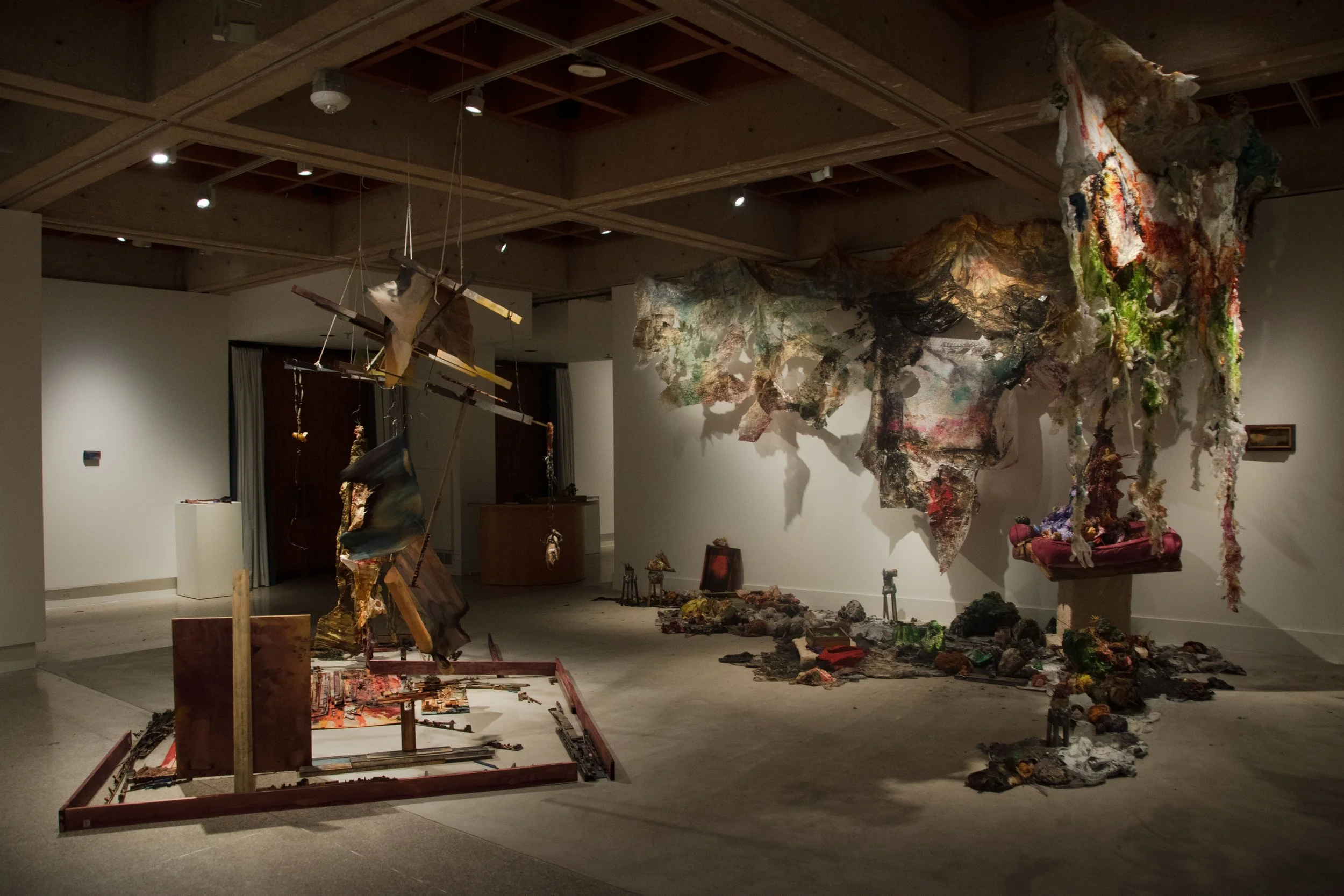
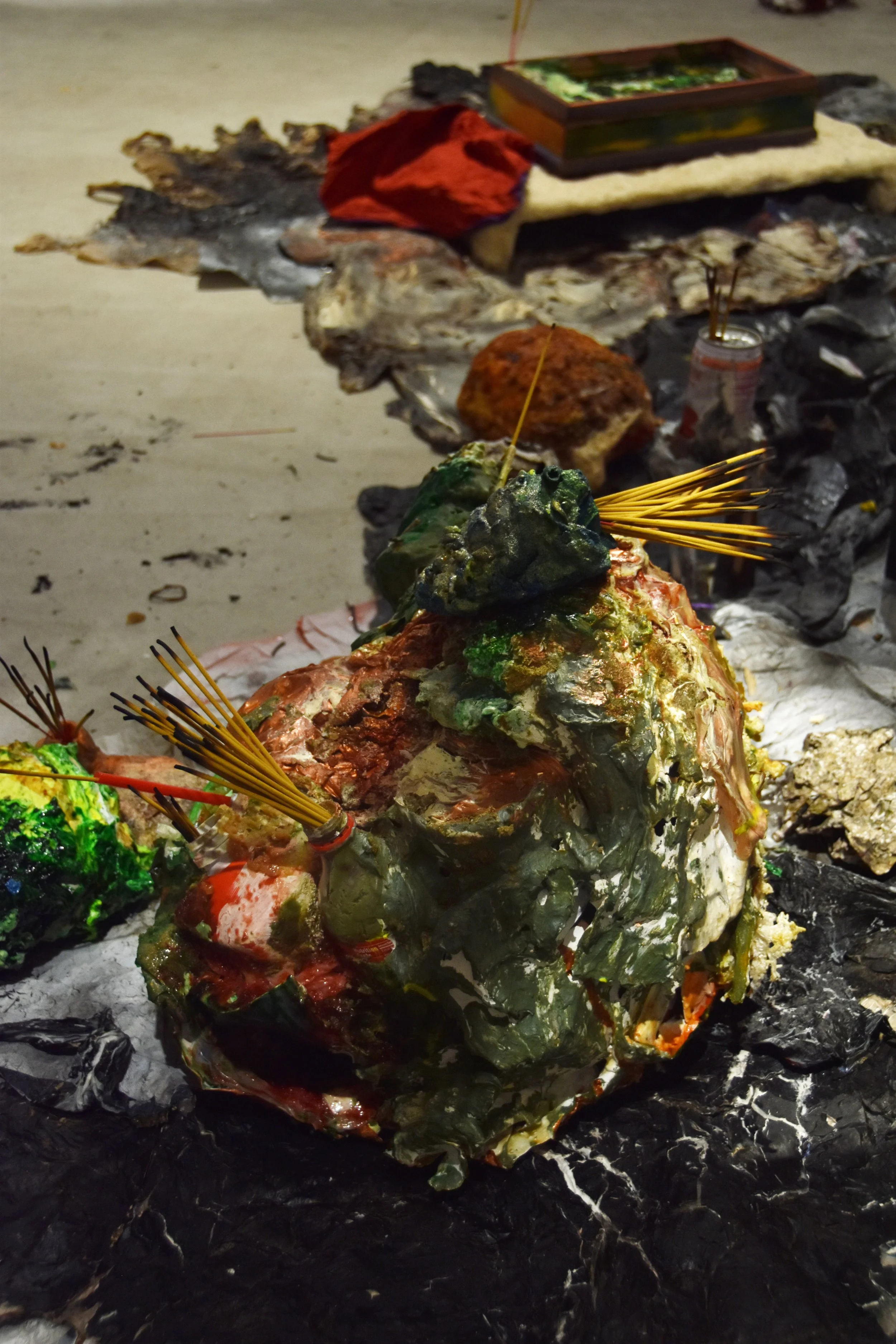
Title: Almshouse (2nd Iteration)
Medium: Aniline dye, acrylic, birch, cotton embroidery floss, cotton rope, detritus, Thai food ingredients, Thai mulberry paper Joomchi, polyester thread, poplar, plastic, wastewater
Dimensions: Variable
Year: 2025
About the Work:
Presented at the University of North Texas's MFA thesis exhibition (Denton, TX), this installation imagines a future ravaged by ecological collapse. Sculptures made from Thai food ingredients, wastewater, plastics, and acrylic are offered to spirit guides and nomadic travelers. Wearable works and dyed wood paintings serve as tools for survival, healing, and ancestral care, reimagining Thai rituals in a desolate world shaped by overconsumption and displacement.
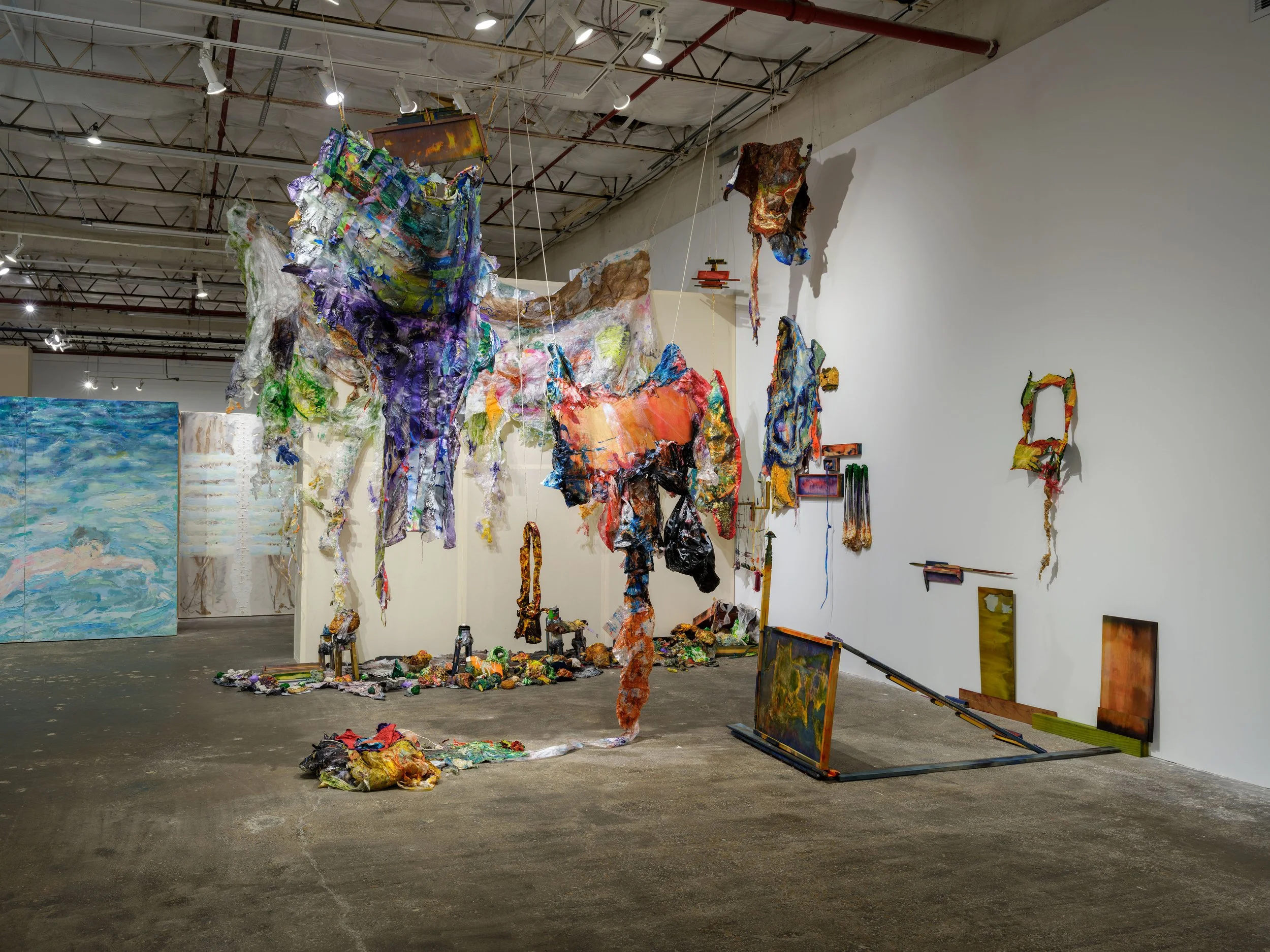
Title: Almshouse (1st Iteration)
Medium: Aniline dye, acrylic, birch, cotton embroidery floss, cotton rope, detritus, Thai food ingredients, Thai mulberry paper Joomchi, polyester thread, poplar, plastic, wastewater
Dimensions: Variable
Year: 2025
About the Work:
This installation at Dallas Contemporary (Dallas, TX) reimagines the gallery as a speculative ruinscape shaped by environmental collapse. Sculptural skins made of single-use plastics, food-based pigments, and paint fragment across walls, floor, and ceiling. Food offerings and aniline dyed wood panels rest on the ground. At the same time, wearable works are suspended or placed along the walls, evoking spirits, waste, and survival in a future where Thai cultural memory persists through material adaptation.
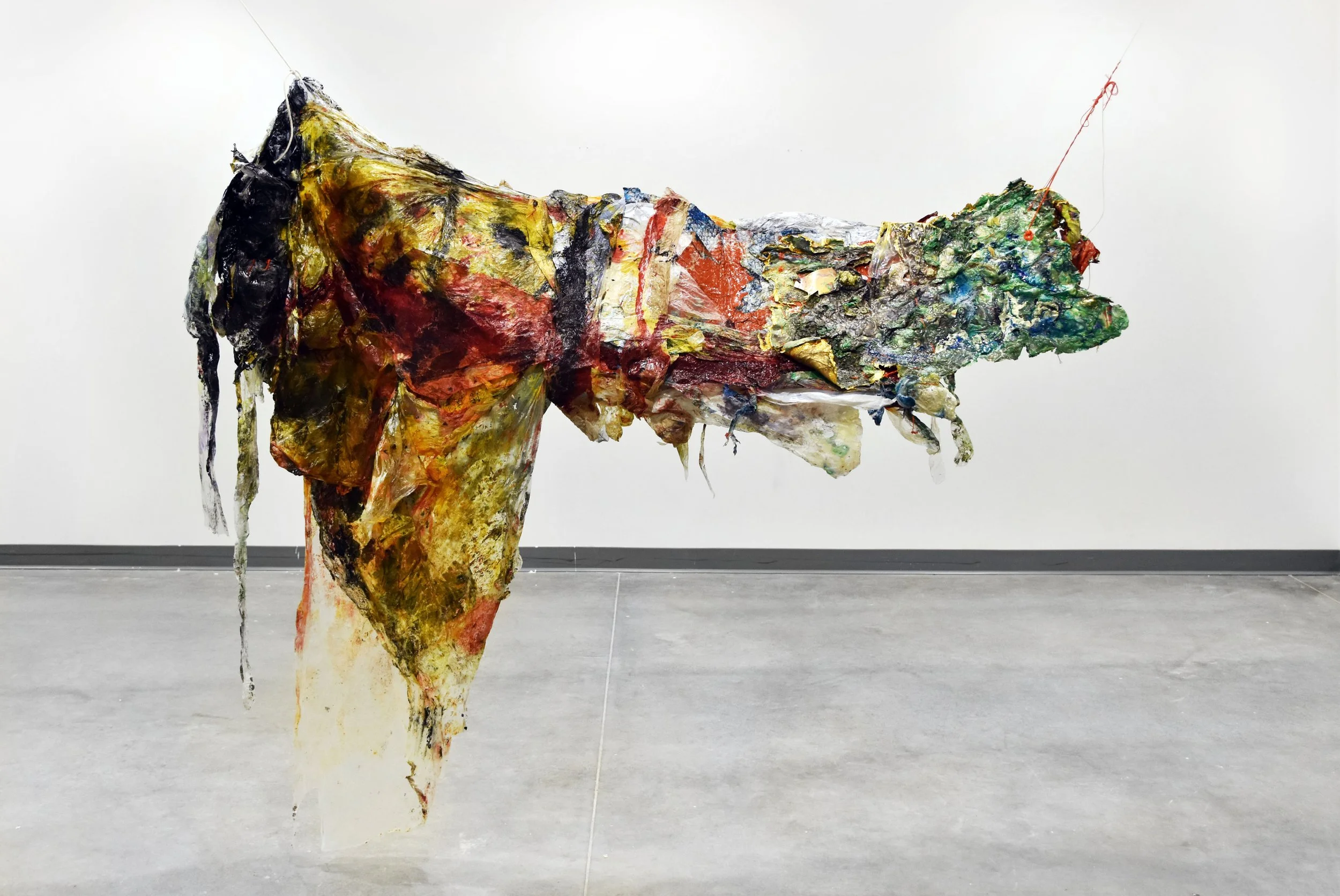
Title: Digester ๔-๗๑ .๗๓.๑๕
Medium: Acrylic, alcohol inks, cotton rope, embroidery floss, Thai food ingredients, wastewater on single-use plastic films
Dimensions: 71 x 73 x 15 inches
Year: 2025
About the Work:
Digester is a series of sculptural paintings that transform waste into a sacred skin, merging fused plastics, Thai food ingredients, and wastewater residue. Inspired by digesters, wastewater vessels that convert discard into energy, I fused plastic films into a textile and allow the paint, food, and waste to evaporate under the Texas sun. This process collaborating with the environment produces topographical imagery as the mixture reduces to a solid.
Drawing from Thai-Buddhist temple mural paintings and animist beliefs, the work imagines spirits residing in plastics, which are made from fossilized life, as guides for wayfinding and ecological atonement. After a fictive ritual has been performed, spiritual digestion occurs on a surface, becoming a topographical map to guide nomadic Thai people into the journey ahead. The work reflects on overconsumption and decay as portals for ritual, survival, and reverence in a future shaped by collapse.
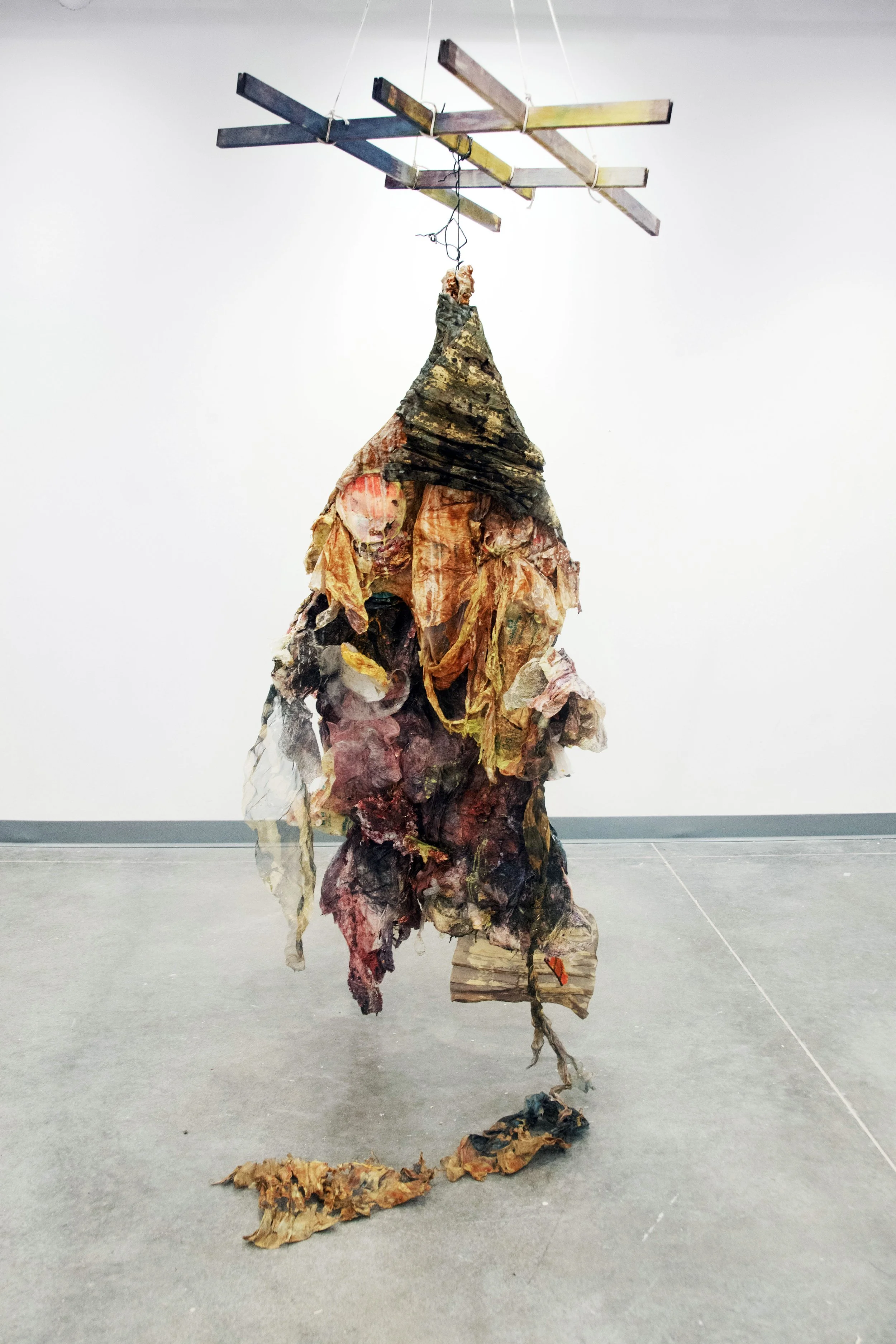

Title: Digester ๘-๖๙.๓๒.๑๕
Medium: Acrylic, alcohol inks, aluminum, aniline dye, bleach, brass, cotton rope, fused single-use plastic films, patina, poplar, Thai food ingredients, wastewater
Dimensions: 71 x 73 x 15 inches
Year: 2025
About the Work:
Digester is a series of sculptural paintings that transform waste into a sacred skin, merging fused plastics, Thai food ingredients, and wastewater residue. Inspired by digesters, wastewater vessels that convert discard into energy, I fused plastic films into a textile and allow the paint, food, and waste to evaporate under the Texas sun. This process collaborating with the environment produces topographical imagery as the mixture reduces to a solid.
Drawing from Thai-Buddhist temple mural paintings and animist beliefs, the work imagines spirits residing in plastics, which are made from fossilized life, as guides for wayfinding and ecological atonement. After a fictive ritual has been performed, spiritual digestion occurs on a surface, becoming a topographical map to guide nomadic Thai people into the journey ahead. The work reflects on overconsumption and decay as portals for ritual, survival, and reverence in a future shaped by collapse.
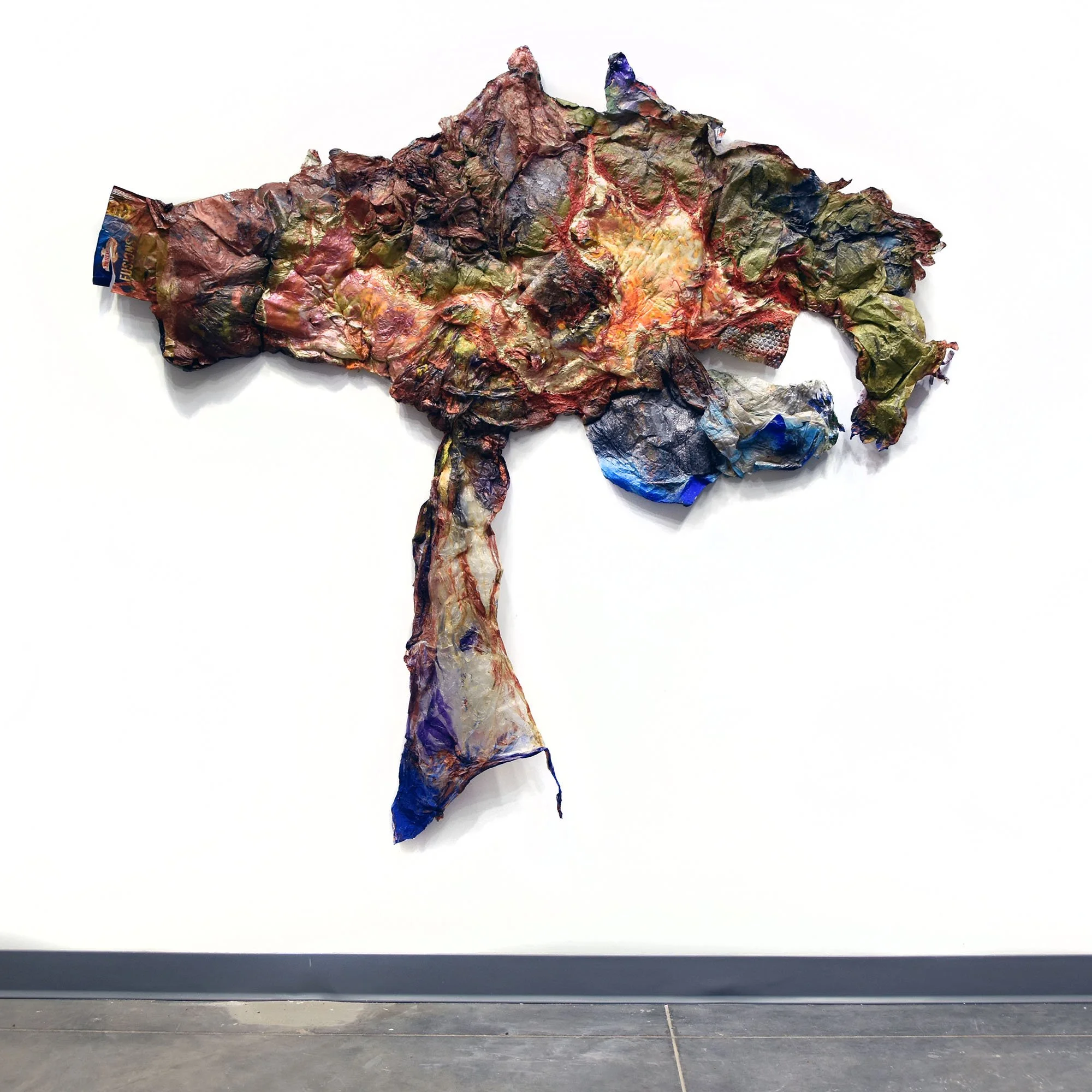
Title: Digester 3-70.0.64.0.01.5
Medium: Acrylic, Thai food ingredients, wastewater on fused single-use plastic films
Dimensions: 70 x 64 x 1.5 inches
Year: 2024
About the Work:
Digester is a series of sculptural paintings that transform waste into a sacred skin, merging fused plastics, Thai food ingredients, and wastewater residue. Inspired by digesters, wastewater vessels that convert discard into energy, I fused plastic films into a textile and allow the paint, food, and waste to evaporate under the Texas sun. This process collaborating with the environment produces topographical imagery as the mixture reduces to a solid.
Drawing from Thai-Buddhist temple mural paintings and animist beliefs, the work imagines spirits residing in plastics, which are made from fossilized life, as guides for wayfinding and ecological atonement. After a fictive ritual has been performed, spiritual digestion occurs on a surface, becoming a topographical map to guide nomadic Thai people into the journey ahead. The work reflects on overconsumption and decay as portals for ritual, survival, and reverence in a future shaped by collapse.
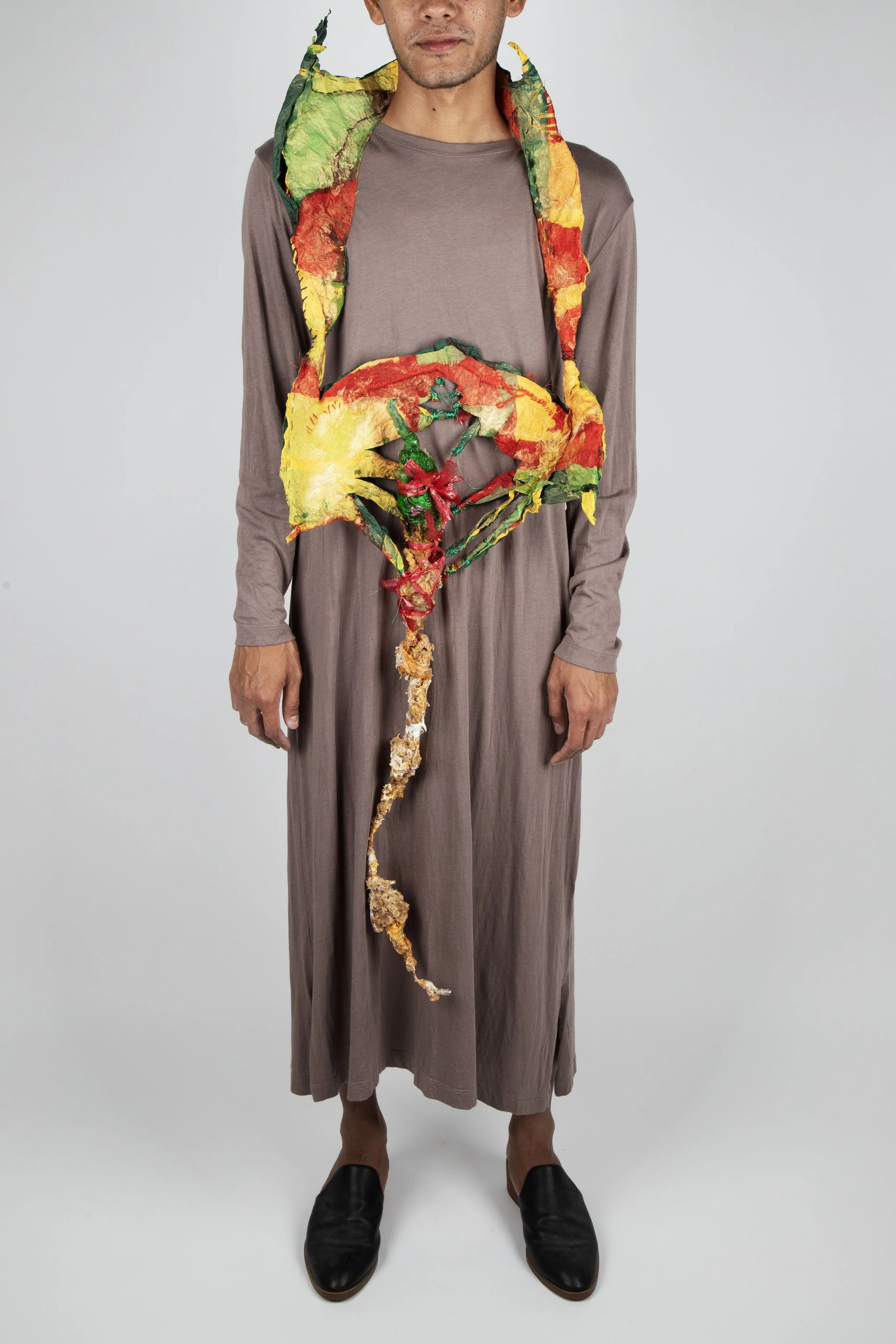
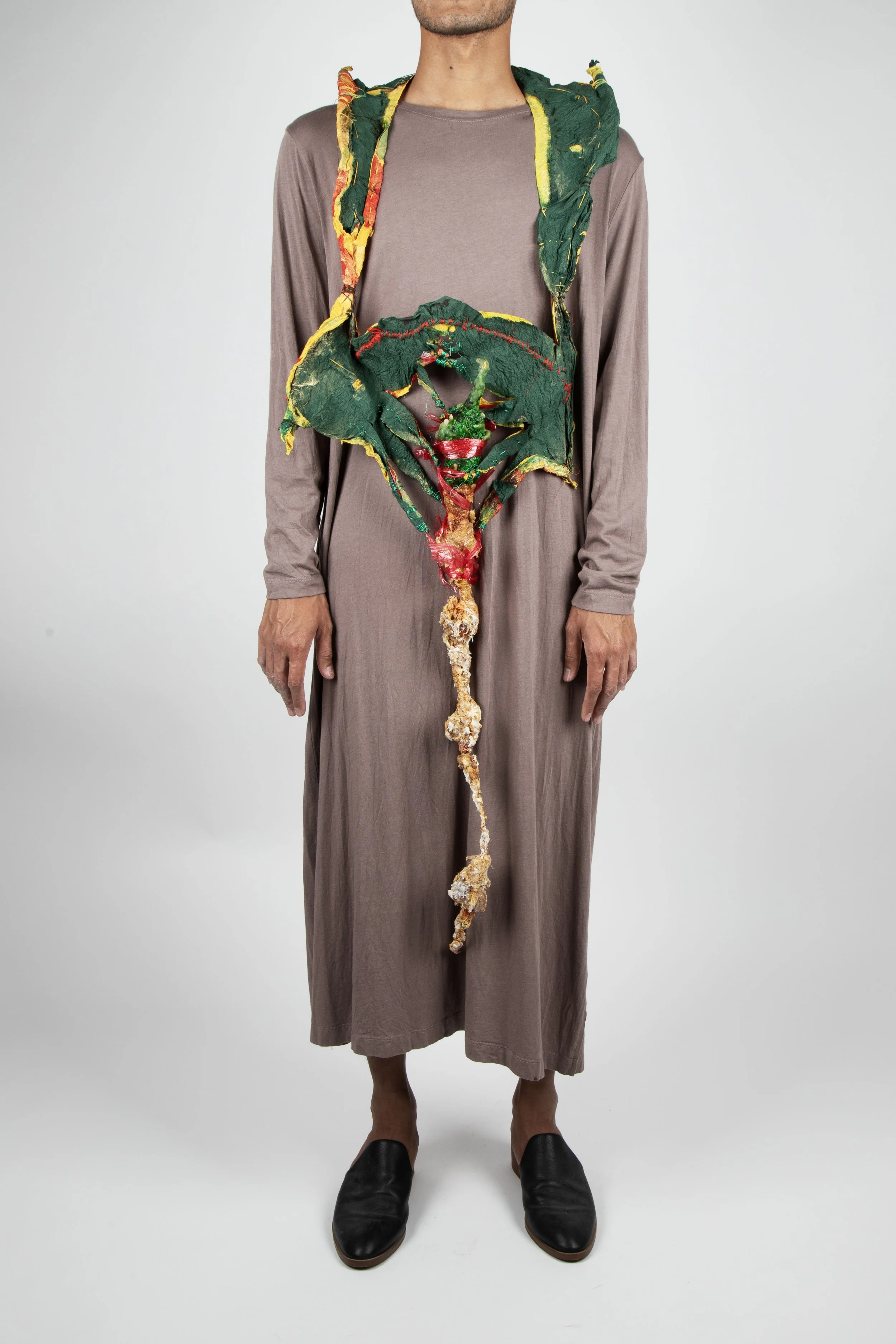
Title: Grandfather’s Epiphyte Necklace ๑-๑๙.๘๗๕.๔๙.๐๐๐.๐๓.๐๐๐
Medium: Acrylic, alcohol inks, embroidery floss, polyester thread, Thai food ingredients, Thai mulberry paper Joomchi, wire
Dimensions: 19.875 x 49 x 3 inches
Year: 2024
About the Work:
My late paternal grandfather and I were not close, but our love for orchids connected us. When I lived in Thailand during my childhood and early teenage years, I would grow up seeing my grandfather working hard, taking care of his orchid garden. I thought his orchids were so beautiful that I decided to have my orchid garden in middle school. I especially love the Vanda orchids, as they have a long root system since they are epiphytic. Epiphytes are plants that draw nutrients from the air and moisture and stay high on trees and other structures. When I moved to the States after 8th grade, I had to leave my orchids behind in Thailand. I no longer grow orchids ever since I lived in the U.S. This feeling of uprootedness from my homeland stayed with me, but I am reminded of the epiphytic orchids and how they thrive. That airplane ride to the U.S. was just a mix of emotions, and at least I was happy to see my maternal side of my family here in the States, as well as the other half of me. My grandfather passed away a couple of years later, leaving his mortal body, and being airborne himself. We both connected by living in this aerial state, looking below from above.
I reimagined this dystopian future in which we are nomads, not finding belonging, uprooted, and forever in a transient state. This necklace embodies this personal narrative of loss and adaptation, finding support in others and growing differently. Instead of being firmly in the ground, being perched up in the air gives us a different vantage point, where things are abstracted and distanced. Maybe one day, like the Vanda orchid, our roots may slowly reach the ground to obtain that original connection to the land we left behind.
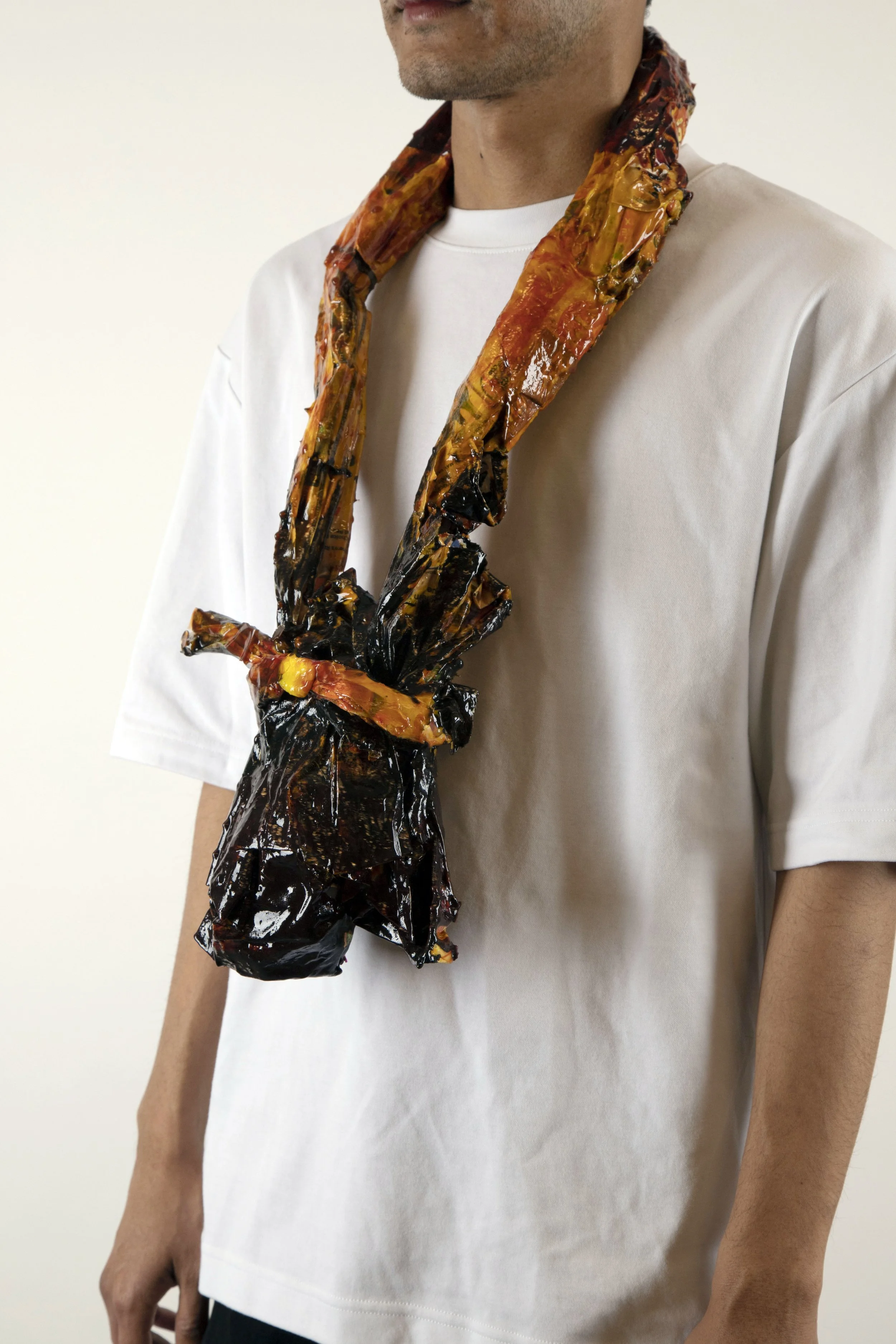
Title: Snack Wrap Necklace BRO-CTG-240804
Medium: Acrylic, Thai food ingredients, weekly advertisements
Dimensions: 24 × 8 × 4 inches
Year: 2025
About the Work:
My mother was a professional chef and our relationship was connected by food. Growing up, I was surrounded by all the delicious meals she could offer her family. My parents moved back to Thailand during my undergraduate college years and would only visit the States once a year. I would experience a sense of famine without her cooking, relying a lot on ultraprocessed food, take out, and frozen meals to survive. Every summer when my mother return to the States for a month in the whole year, I experience fullness that feeds me spiritually, connecting me to Thailand despite being so far away.
Since the work is placed in this fictive future of collapse, I reimagine Thai cuisine as a wearable relic. Heavily inspired by my mother’s cooking background and migration, convenience food, and Buddhist amulets, food is now a form of spiritual armor and physical sustenance for these Thai nomads of tomorrow. Food reminds us of home and care that stays with us despite being “on the go.”
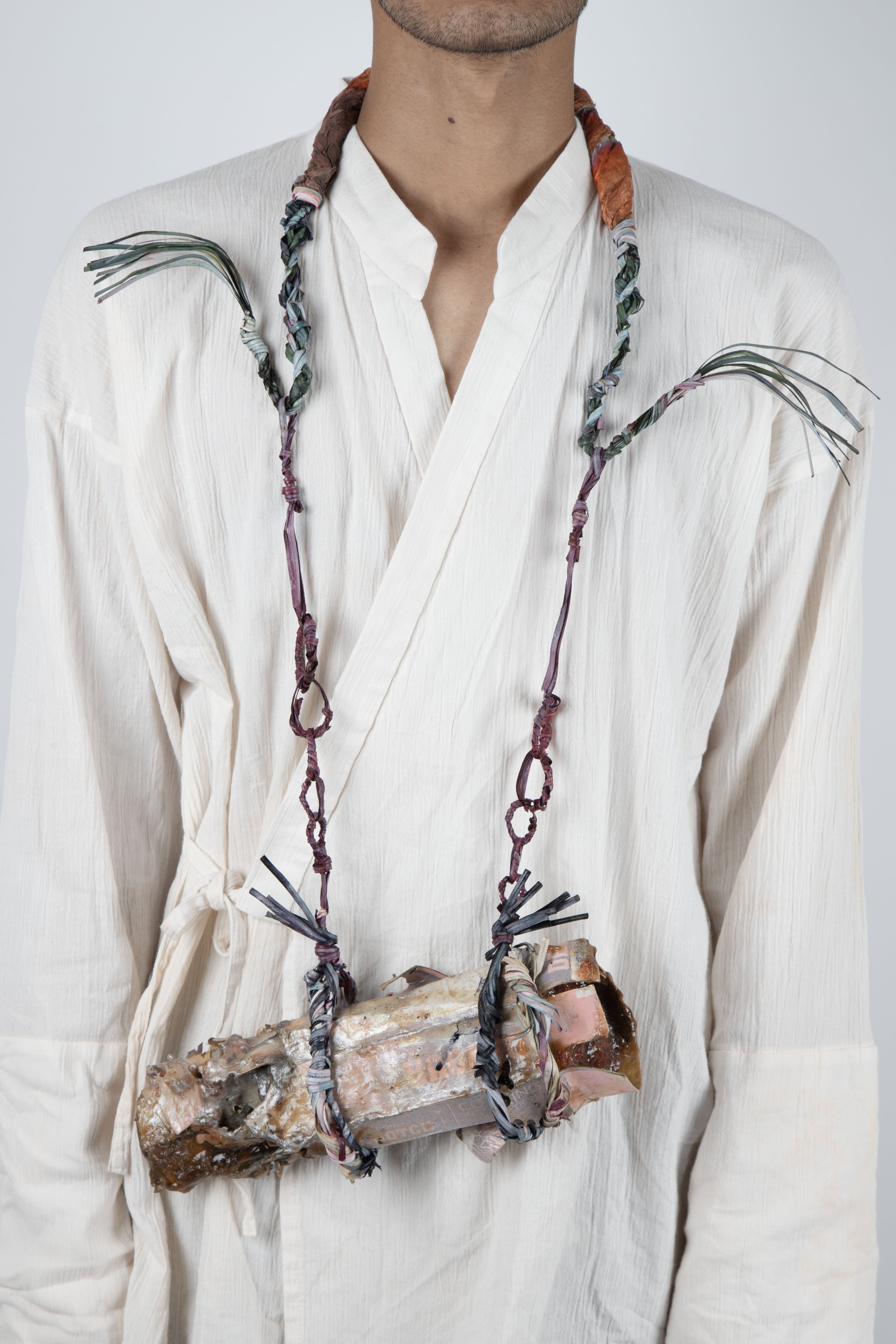
Title: Snack Wrap Necklace WGR - ๒๙.๑๑.๐๔
Medium: Acrylics, aniline dye, copper mesh, frozen food cardboard box, laser etching and cutting, Thai food ingredients, patina, twist ties
Dimensions: 29 x 11 x 4 inches
Year: 2025
About the Work:
My mother was a professional chef and our relationship was connected by food. Growing up, I was surrounded by all the delicious meals she could offer her family. My parents moved back to Thailand during my undergraduate college years and would only visit the States once a year. I would experience a sense of famine without her cooking, relying a lot on ultraprocessed food, take out, and frozen meals to survive. Every summer when my mother return to the States for a month in the whole year, I experience fullness that feeds me spiritually, connecting me to Thailand despite being so far away.
Since the work is placed in this fictive future of collapse, I reimagine Thai cuisine as a wearable relic. Heavily inspired by my mother’s cooking background and migration, convenience food, and Buddhist amulets, food is now a form of spiritual armor and physical sustenance for these Thai nomads of tomorrow. Food reminds us of home and care that stays with us despite being “on the go.”
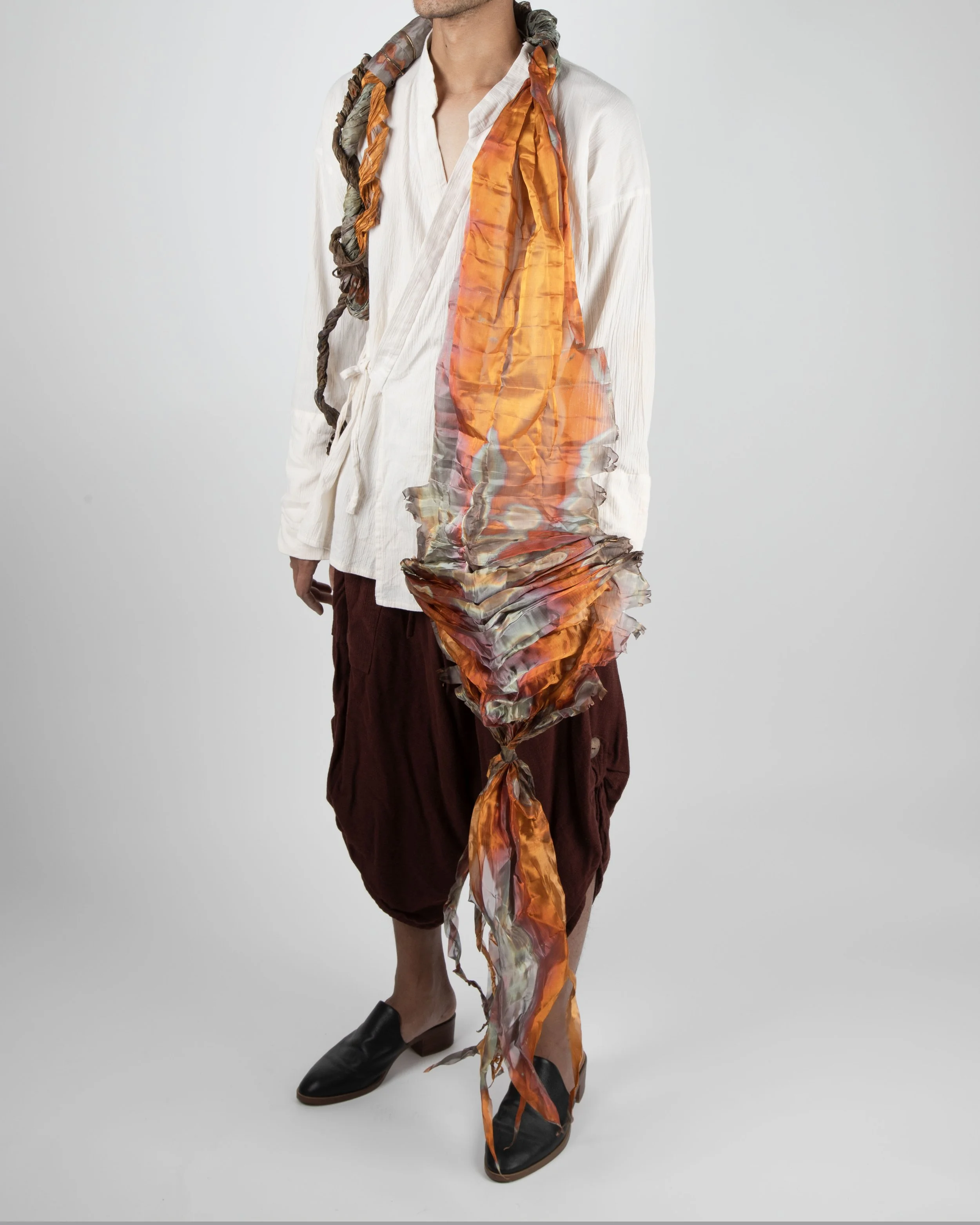
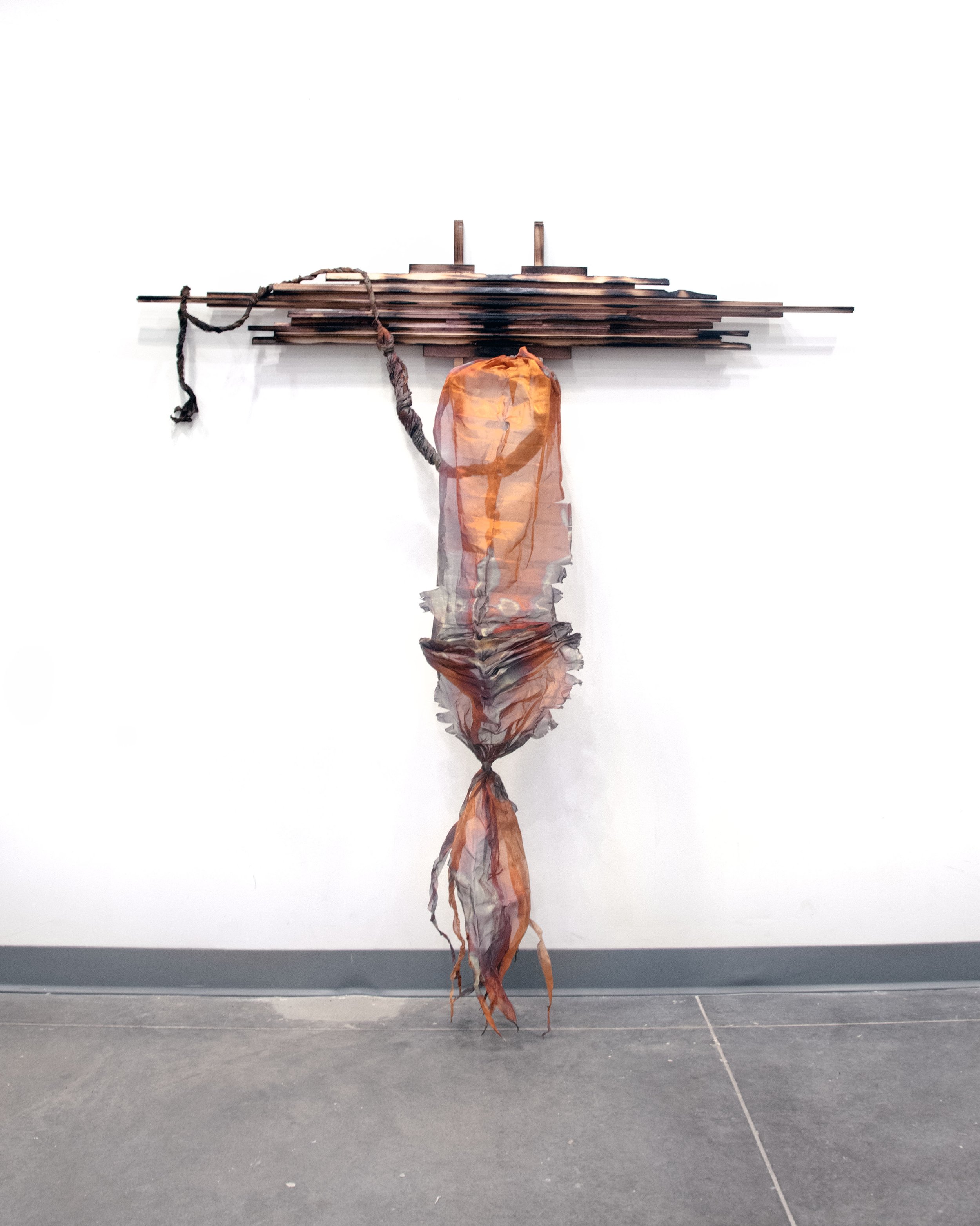
Title: Severed Sabai ๒
Medium: Brass wire, copper mesh, patina with aniline dyed and flame treated poplar wooden hanger
Dimensions: 121 × 16 × 5 inches
Year: 2025
About the Work:
This wearable sculpture reinterprets the sabai, a traditional shoulder cloth shared across Southeast Asian cultures,through patinated metal mesh using heat and Thai food-based materials. Suspended between fragility and armor, it explores filtration, displacement, and the remnants of cultural memory in the wake of ecological and diasporic rupture.
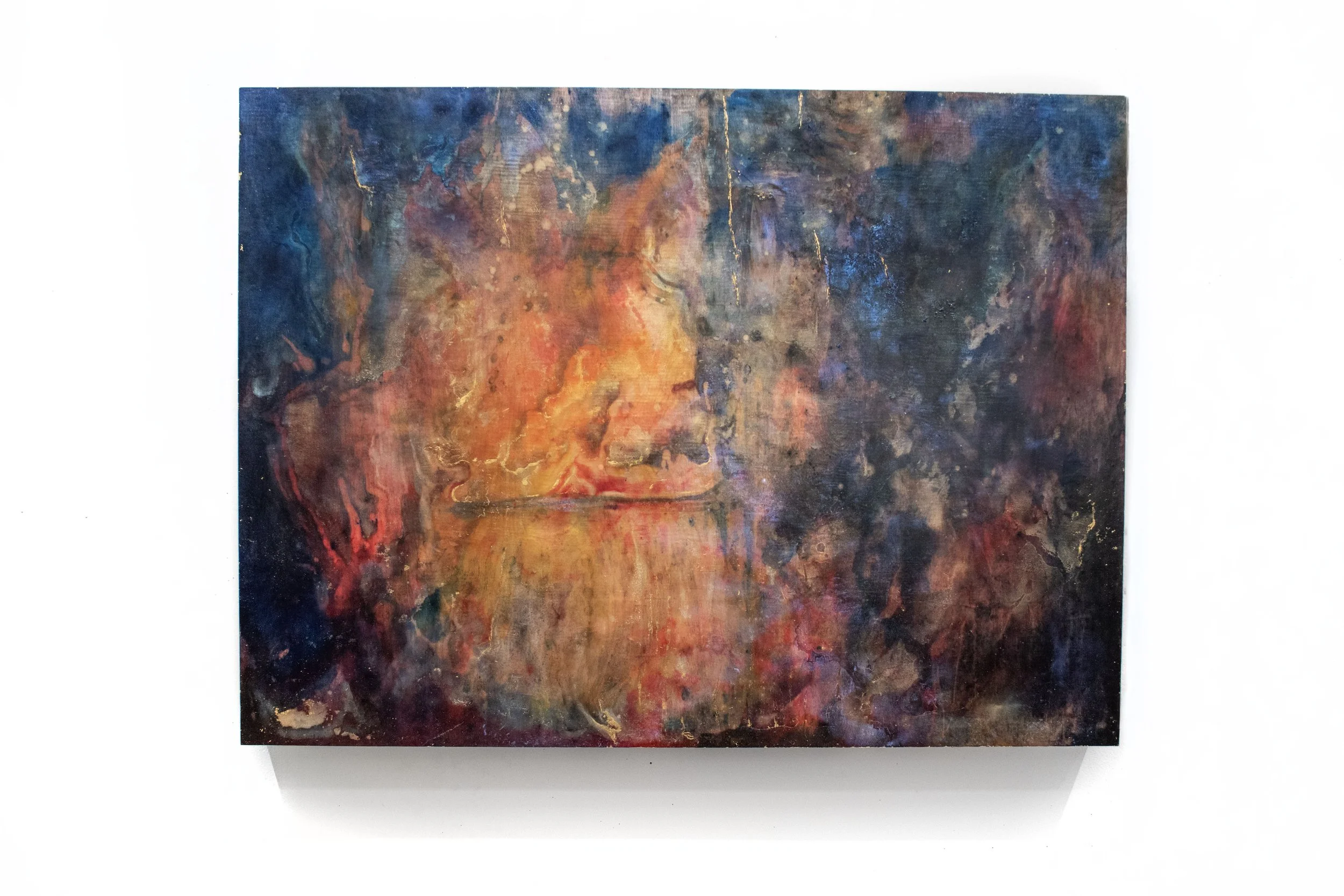
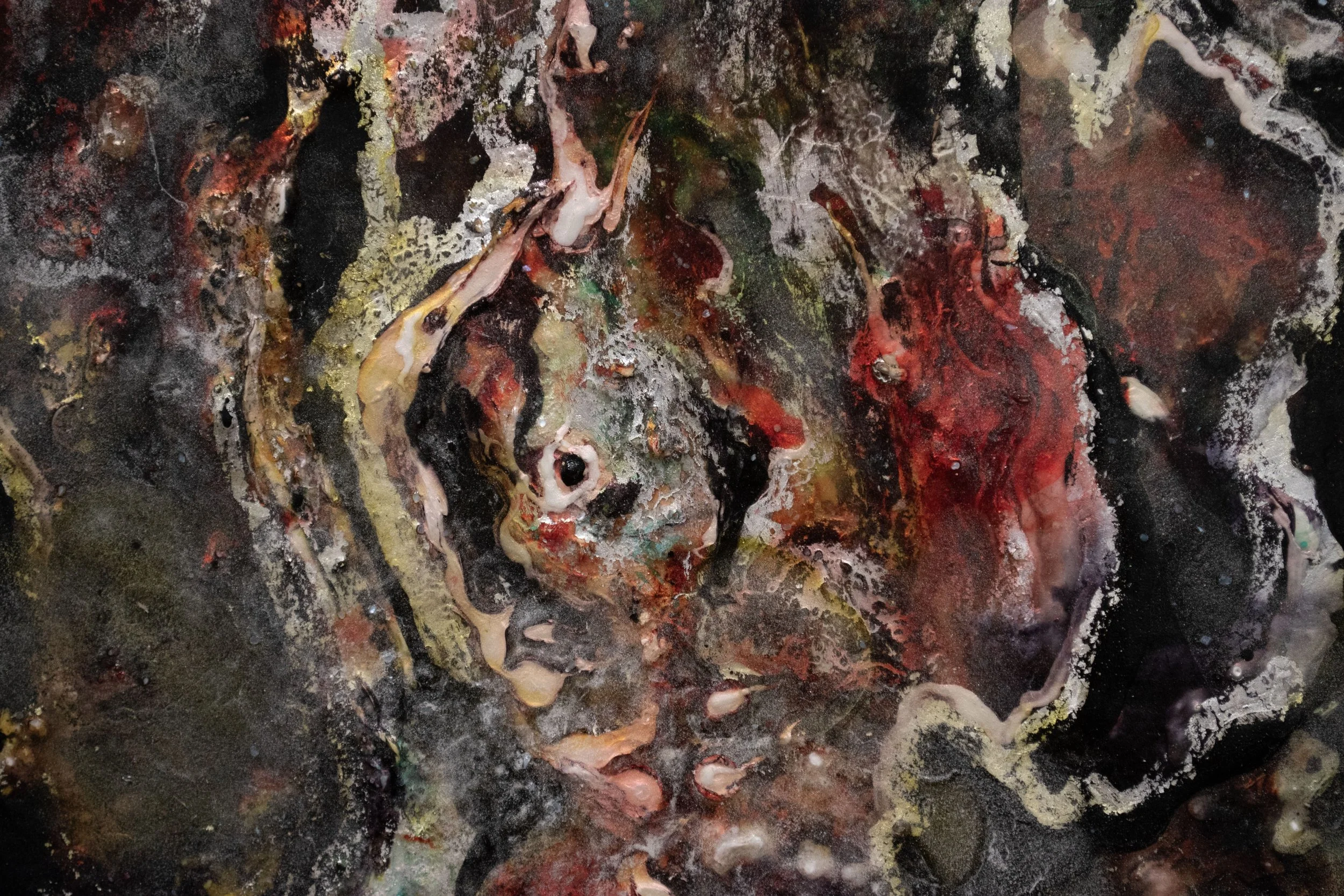
Title: Underneath the Skin of My Mother’s Clothing ๕๖
Medium: 24k gold leaf, acrylic, aniline wood dye, bleach, hide glue, mica, residue, varnish, water-based size on birch and poplar wood panel
Dimensions: 35 x 47 x 3.5 inches
Year: 2026
About the Work:
Works from my Underneath the Skin of My Mother’s Clothing series are a reflection on the inaccessibility of healthcare and the sanctity of the body. I imagined a future of ecological and infrastructural collapse, in which Thai people had to be creative in their survival by relying on their ancestral knowledge. Unfortunately, this future is very present right now, with health concerns being highly commodified in the US. Wellness and care have increasingly become out of reach.
I look to wood as a medium, the traditions of Thai lacquerware and textile dyeing, and environmental science to consider alternatives to our current state of healthcare. Trees naturally take up environmental contaminants through phytoremediation, and are often planted around landfills for this purpose. My days in the environmental science testing lab involved producing bright colors to detect analytes such as cyanide, phosphorus, and phenolics through colorimetry. Can colors from dyes, the healing properties of wood, and maybe our own bodily and spiritual essence all come together to form some kind of medical diagnostics that reveal our internal world?
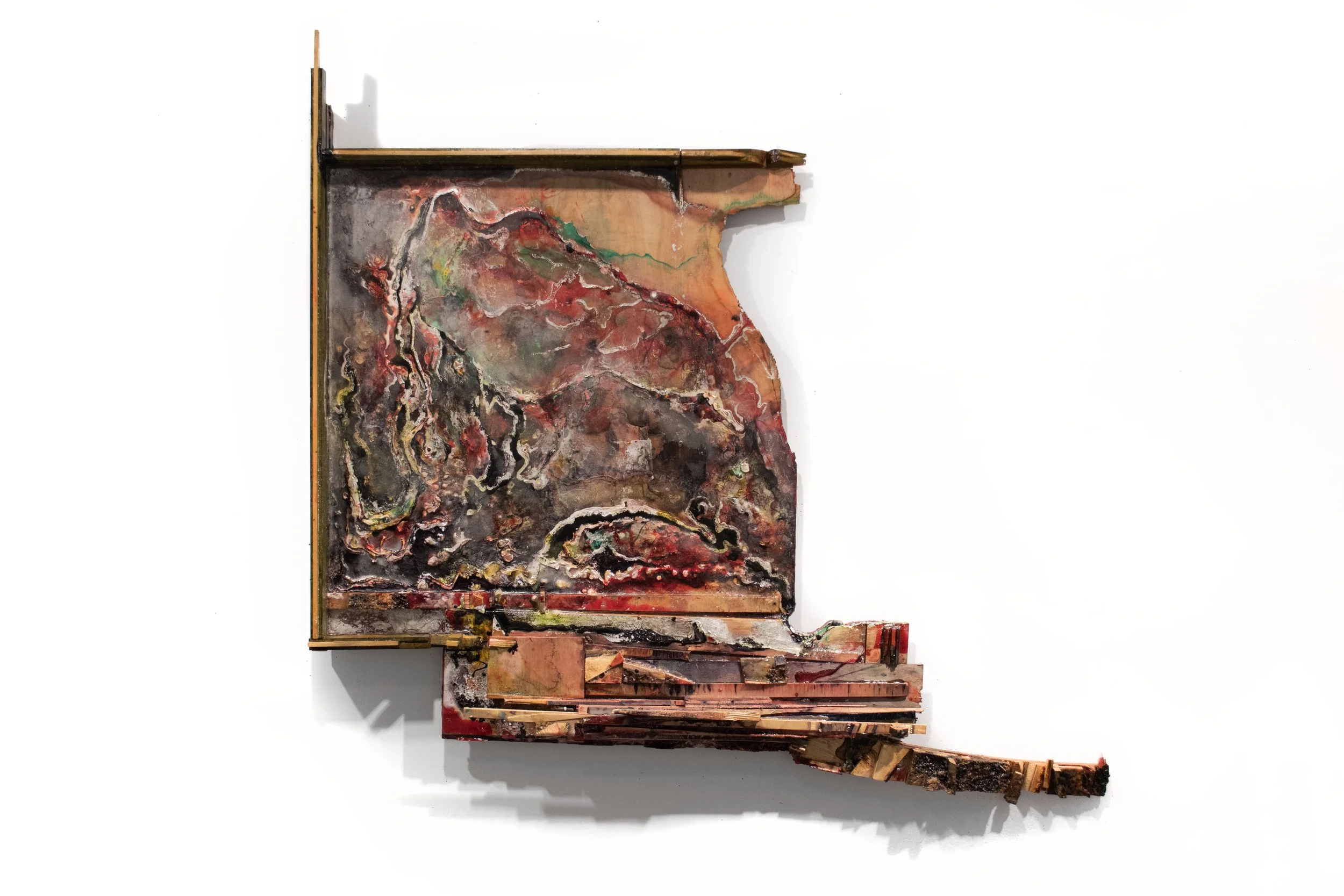
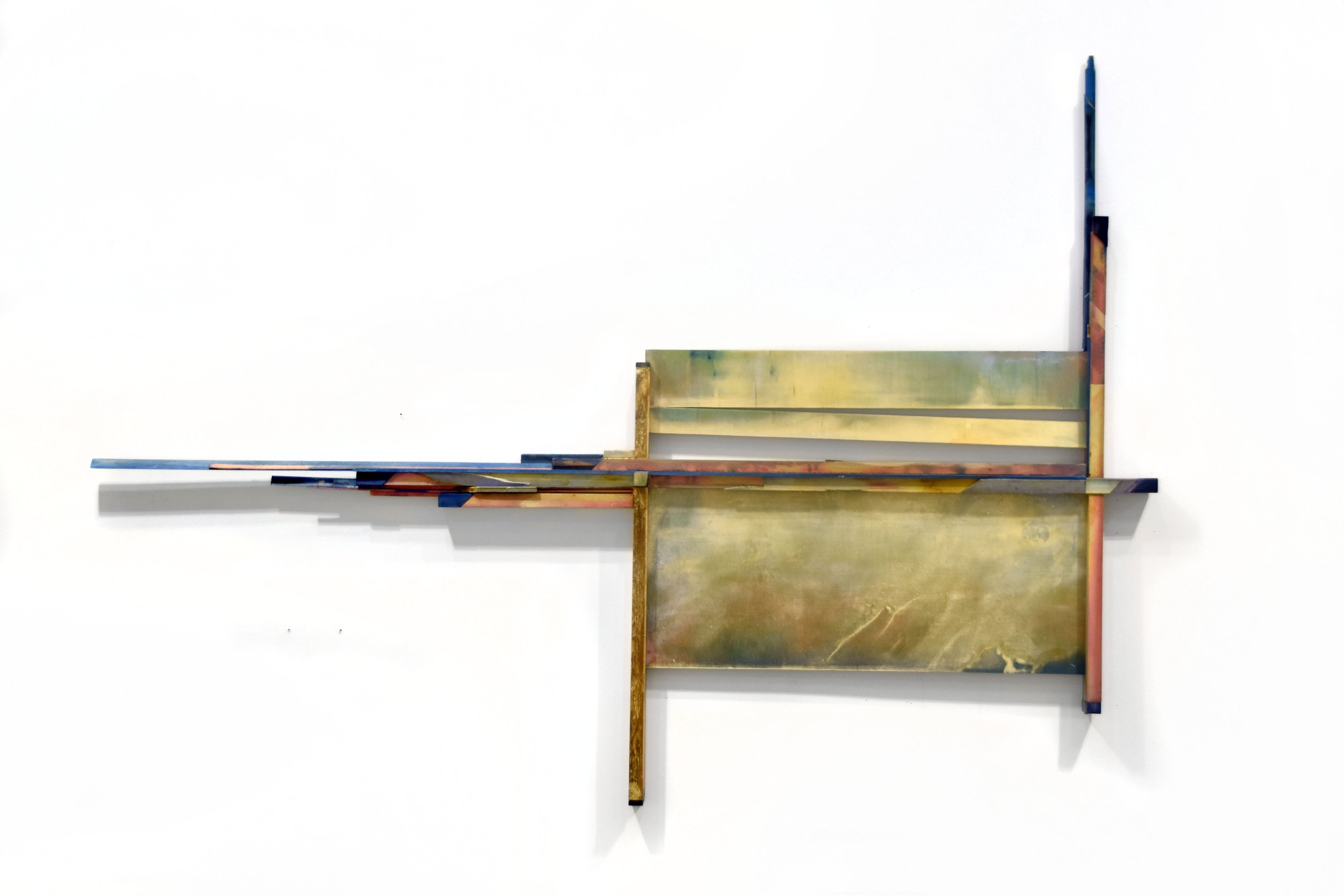
Title: Underneath the Skin of My Mother’s Clothing ๕๕
Medium: Acrylic, aniline wood dye, bleach, hide glue, mica, saw dust, silver leaf, silver powder, Transtint dye, residue, varnish, water-based size, wood glue on birch and poplar wood panel
Dimensions: 42 × 43× 2.6 inches
Year: 2026
About the Work:
Works from my Underneath the Skin of My Mother’s Clothing series are a reflection on the inaccessibility of healthcare and the sanctity of the body. I imagined a future of ecological and infrastructural collapse, in which Thai people had to be creative in their survival by relying on their ancestral knowledge. Unfortunately, this future is very present right now, with health concerns being highly commodified in the US. Wellness and care have increasingly become out of reach.
I look to wood as a medium, the traditions of Thai lacquerware and textile dyeing, and environmental science to consider alternatives to our current state of healthcare. Trees naturally take up environmental contaminants through phytoremediation, and are often planted around landfills for this purpose. My days in the environmental science testing lab involved producing bright colors to detect analytes such as cyanide, phosphorus, and phenolics through colorimetry. Can colors from dyes, the healing properties of wood, and maybe our own bodily and spiritual essence all come together to form some kind of medical diagnostics that reveal our internal world?
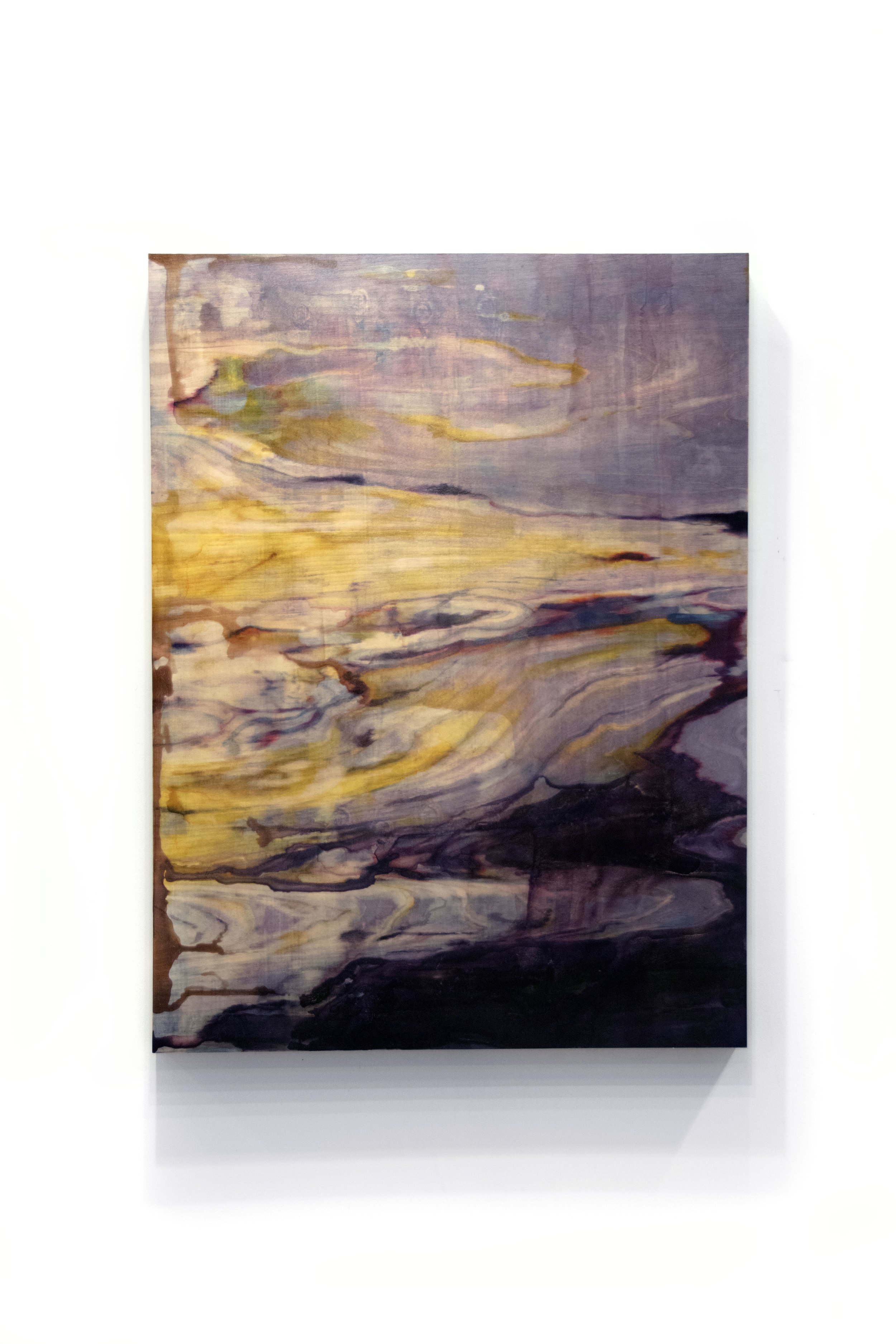
Title: Underneath the Skin of My Mother’s Clothing ๔๑
Medium: Acrylic, aniline wood dye, laser etching on birch and poplar wood panel
Dimensions: 55.25 x 39 x 2.5 inches
Year: 2026
About the Work:
Works from my Underneath the Skin of My Mother’s Clothing series are a reflection on the inaccessibility of healthcare and the sanctity of the body. I imagined a future of ecological and infrastructural collapse, in which Thai people had to be creative in their survival by relying on their ancestral knowledge. Unfortunately, this future is very present right now, with health concerns being highly commodified in the US. Wellness and care have increasingly become out of reach.
I look to wood as a medium, the traditions of Thai lacquerware and textile dyeing, and environmental science to consider alternatives to our current state of healthcare. Trees naturally take up environmental contaminants through phytoremediation, and are often planted around landfills for this purpose. My days in the environmental science testing lab involved producing bright colors to detect analytes such as cyanide, phosphorus, and phenolics through colorimetry. Can colors from dyes, the healing properties of wood, and maybe our own bodily and spiritual essence all come together to form some kind of medical diagnostics that reveal our internal world?
Title: Underneath the Skin of My Mother’s Clothing ๔๙
Medium: Acrylic, aniline dye, bleach on birch and poplar panel
Dimensions: 40 x 30 x 2.6 inches
Year: 2025
About the Work:
Works from my Underneath the Skin of My Mother’s Clothing series are a reflection on the inaccessibility of healthcare and the sanctity of the body. I imagined a future of ecological and infrastructural collapse, in which Thai people had to be creative in their survival by relying on their ancestral knowledge. Unfortunately, this future is very present right now, with health concerns being highly commodified in the US. Wellness and care have increasingly become out of reach.
I look to wood as a medium, the traditions of Thai lacquerware and textile dyeing, and environmental science to consider alternatives to our current state of healthcare. Trees naturally take up environmental contaminants through phytoremediation, and are often planted around landfills for this purpose. My days in the environmental science testing lab involved producing bright colors to detect analytes such as cyanide, phosphorus, and phenolics through colorimetry. Can colors from dyes, the healing properties of wood, and maybe our own bodily and spiritual essence all come together to form some kind of medical diagnostics that reveal our internal world?